
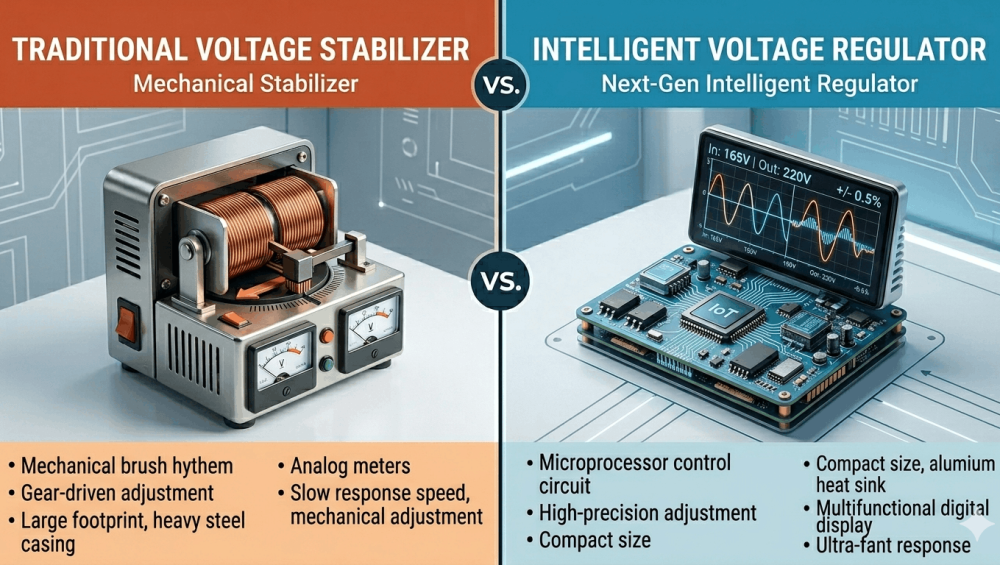
When it comes to safeguarding electrical systems, both traditional voltage stabilizers and Next-Generation Intelligent Voltage Regulators share a foundational mission: maintaining a steady output voltage. However, beneath the surface lies a massive technological divide.
The next-generation intelligent regulator has been engineered from the ground up with breakthrough advancements in automation, precision, response latency, and proactive system protection. Understanding these differences is crucial for selecting the right infrastructure for your home or business.
1. Deep Dive into Both Technologies
Traditional Voltage Stabilizers (The Legacy Approach)
Traditional stabilizers are purely reactive, hardware-driven devices designed for basic voltage correction. Most of these units rely on mechanical servo motors, carbon brushes, or relay-switching mechanisms to physically adjust the transformer turns ratio when input voltage fluctuates.
-
The Pros: Very low initial capital investment (CapEx), proven and straightforward technology, and easy to maintain by standard technicians. They are perfectly adequate for simple appliances in environments with predictable, slow-moving voltage drifts.
-
The Limitations:
-
Mechanical Wear and Tear: Moving parts like carbon brushes degrade over time, requiring periodic replacement and risking sparks.
-
Slow Response Time: Because they rely on physical movement, there is a noticeable time lag (often several hundred milliseconds to seconds) before the voltage is corrected. This delay can be fatal for sensitive electronics.
-
Blind Operations: They offer virtually no data insights, remote monitoring, or integration into modern energy management ecosystems.
-
Next-Generation Intelligent Voltage Regulators (The Modern Solution)
These next-gen units represent a paradigm shift. Moving away from mechanical parts, they utilize solid-state power electronics (such as SCRs or IGBTs) controlled by advanced microprocessors or Digital Signal Processors (DSP). They do not just stabilize voltage; they act as an intelligent energy management hub.
-
The Pros:
-
Ultra-Fast Response: Voltage correction happens almost instantaneously (typically within a few milliseconds), neutralizing spikes before they reach your equipment.
-
Proactive Multi-Layer Protection: Equipped with software-defined thresholds to instantly isolate loads during catastrophic over-voltage, under-voltage, over-current, phase loss, or short-circuit events.
-
Smart Ecosystem Integration (IoT): Features real-time data logging, remote mobile app monitoring, fault diagnostics, and seamless integration into Smart Home or Industrial SCADA systems.
-
-
The Limitations: Higher upfront cost and requires specialized technical knowledge if complex firmware configurations or troubleshooting are needed.
2. Head-to-Head Comparison Matrix
| Technical Parameters | Traditional Voltage Stabilizer | Next-Gen Intelligent Voltage Regulator |
| Control Core | Electro-mechanical (Servo motor, Carbon brushes, Relays) | Solid-state electronics (Microprocessors, DSP, SCR/IGBT) |
| Response Speed | Slow ($300\text{ms} – 1\text{s}$ or more) | Near-instantaneous ($2\text{ms} – 20\text{ms}$) |
| Voltage Precision | Moderate ($\pm 2\%$ to $\pm 5\%$) | High precision ($\pm 0.5\%$ to $\pm 1\%$) |
| Lifespan & Maintenance | Requires periodic maintenance due to mechanical friction | Maintenance-free solid-state architecture (No moving parts) |
| Protection Scope | Basic (Analog fuses or thermal circuit breakers) | Comprehensive (Micro-controlled multi-layer safety trips) |
| Connectivity & Data | None (Static analog/digital display meters only) | IoT-enabled, cloud monitoring, mobile alerts, RS485/Modbus |
| Harmonic Distortion | Can introduce noise due to brush arcing | Zero or extremely low distortion (Pure sine wave output) |
3. Which One Should You Invest In?
The choice between these two systems hinges on the financial value, sensitivity, and operational criticality of your connected equipment.
Opt for a Traditional Stabilizer if: You are on a tight budget and your primary goal is to support resilient, non-critical loads—such as basic lighting, standard fans, old-generation refrigerators, or simple heating elements—in areas where power grid fluctuations are gradual rather than violent.
Upgrade to an Intelligent Regulator if: You are protecting high-value, highly sensitive assets. This includes high-end audio systems (Hi-Fi), medical equipment, data servers, automated industrial machinery, or integrated Smart Home infrastructure. It is the definitive choice if your operations demand 24/7 uptime, zero tolerance for data corruption, or if you require remote facility management capabilities.
Conclusion
The fundamental difference between a traditional stabilizer and a Next-Generation Intelligent Voltage Regulator is reactive correction versus proactive management. While legacy stabilizers wait for a voltage drop to mechanically adjust, intelligent regulators utilize microsecond-level computing to actively shield your infrastructure.
As modern electronics become increasingly sophisticated and sensitive to power quality, transitioning to intelligent voltage regulation is no longer a luxury—it is a vital, future-proof investment for long-term operational security.