
In an era driven by automation, digital transformation, and sensitive electronic components, maintaining power quality is no longer a luxury—it is a operational necessity. The Next-Generation Intelligent Voltage Regulator (IVR) represents a major leap forward from traditional static stabilizers. By integrating advanced microprocessors, real-time monitoring, and automated correction algorithms, the IVR ensures a flawless, continuous power supply.
For regions plagued by grid instability or industries relying on high-precision equipment, this technology serves as a vital safeguard. Below is a detailed breakdown of the primary benefits that Next-Generation IVRs bring to modern electrical ecosystems.
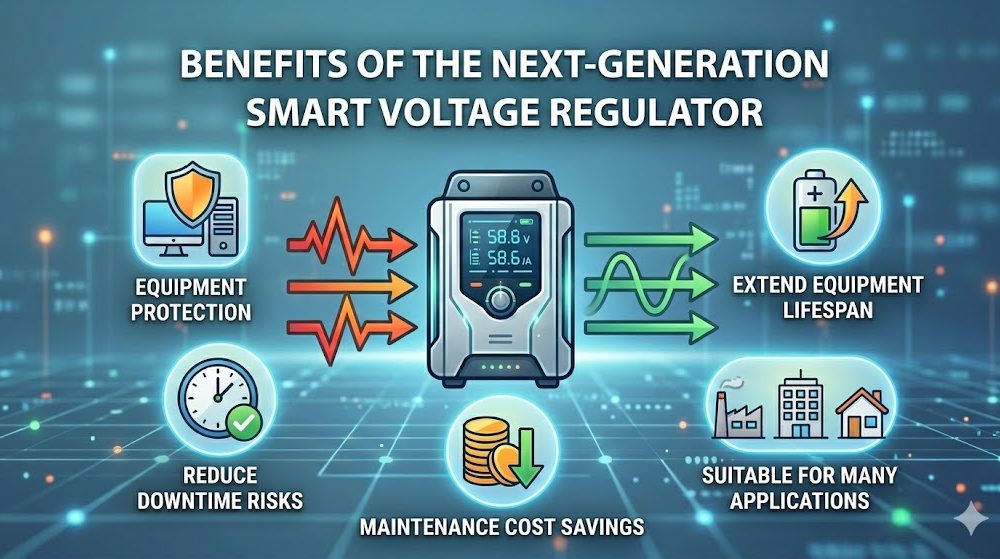
1. Advanced Equipment Protection
Fluctuations in power grids—such as transient voltage surges, sags, swells, and brownouts—are silent killers for modern electronics. Traditional regulators often react too slowly, allowing harmful spikes to pass through.
-
Millisecond Response Times: Next-generation IVRs utilize high-speed digital signal processors (DSPs) to detect voltage anomalies and correct them within milliseconds.
-
Dynamic Voltage Correction: Whether the grid experiences a sudden drop (sag) or an over-voltage spike (swell), the intelligent regulator dynamically adjusts the output to a safe, steady nominal level.
-
Total Isolation from Grid Noise: Beyond simple regulation, these smart devices often filter out electromagnetic interference (EMI) and radio frequency interference (RFI), delivering clean “pure sine wave” power to critical loads.
2. Minimizing Costly Downtime
For commercial enterprises, manufacturing plants, and data centers, power disruptions translate directly into financial loss. A fraction of a second of under-voltage can trip a programmable logic controller (PLC) or crash a server.
-
Operational Continuity: By maintaining voltage within strict tolerances, the IVR prevents unexpected system reboots, data corruption, and production line halts.
-
Smart Grid Adaptation: Intelligent regulators can predict minor grid anomalies based on historical data trends, seamlessly smoothing out transitions without forcing equipment into “safe mode” or relying prematurely on backup generators (UPS), thereby conserving UPS battery life.
3. Maximizing Equipment Lifespan
When electrical appliances and industrial machinery are subjected to persistent under-voltage or over-voltage, they suffer from chronic thermal stress.
-
Mitigating Thermal Stress: Electric motors running on low voltage draw higher current to compensate, leading to overheating and insulation breakdown. Conversely, over-voltage stresses capacitors and semiconductor junctions.
-
Optimal Operating Conditions: By guaranteeing a constant, optimal voltage, the intelligent regulator ensures components operate exactly within their manufacturer-specified design parameters. This drastically slows down the rate of internal wear and tear, effectively extending the operational lifespan of your assets by years.
4. Substantial Reduction in Maintenance and Capital Costs
The long-term financial return on investing in a next-generation IVR is realized through the optimization of maintenance budgets.
-
Fewer Component Failures: With the elimination of power-induced stress, the frequency of hardware burnouts, blown fuses, and fried circuit boards drops significantly.
-
Predictive Maintenance Analytics: Modern intelligent regulators are equipped with IoT capabilities (Internet of Things). They log power quality data and communicate system health. This allows maintenance teams to fix localized grid issues before they cause equipment failure, shifting the business from reactive firefighting to proactive asset management.
-
Lower Total Cost of Ownership (TCO): Decreased emergency repair costs and delayed equipment replacement cycles ensure the IVR pays for itself rapidly.
5. High Versatility and Diverse Applications
One of the defining features of next-generation intelligent regulators is their scalability and adaptability to various load profiles and environmental conditions. They are engineered to cater to a vast spectrum of applications:
| Application Level | Typical Use Cases | Recommended Configuration |
| Residential & Light Commercial | Smart homes, luxury villas, retail shops, medical clinics, and office servers. | Single-Phase (1-Phase) / Wall-Mounted Regulators: Compact, aesthetically sleek, and silent. |
| Industrial & Heavy Duty | Smart factories, CNC machining centers, automated packaging lines, data centers, and hospital imaging equipment (MRI/CT scans). | Three-Phase (3-Phase) Regulators: High-capacity systems capable of balancing asymmetrical loads across phases. |
Furthermore, these units feature user-friendly digital interfaces (LCD touchscreens) and support integration into broader Building Management Systems (BMS) or Industrial SCADA networks via protocols like Modbus or Ethernet.
Conclusion
The Next-Generation Intelligent Voltage Regulator is far more than a reactionary buffer against poor grid quality; it is a proactive, strategic asset for modern power management. By blending real-time digital precision with robust electrical engineering, it delivers unparalleled equipment protection, eliminates costly operational downtime, and optimizes long-term maintenance costs. Investing in a smart IVR is the ultimate step toward building a resilient, future-ready, and highly efficient electrical infrastructure.