
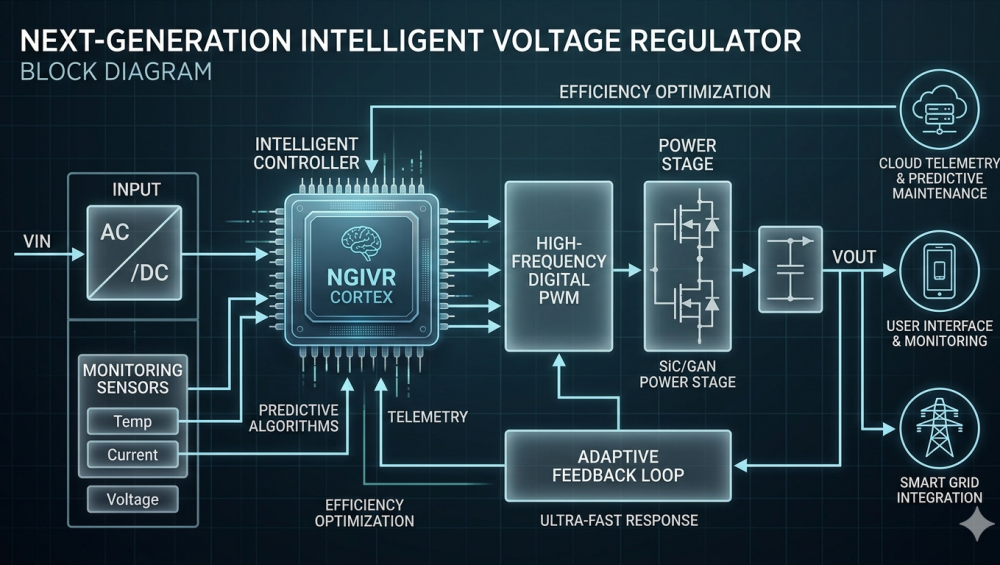
In the rapidly evolving landscape of electronics, traditional power management systems are hitting their limits. As microprocessors become more powerful, electric vehicles (EVs) demand higher efficiency, and renewable energy sources introduce grid instability, the need for smarter power regulation has never been more critical. Enter the Next-Generation Intelligent Voltage Regulator (NGIVR).
What is a Next-Generation Intelligent Voltage Regulator?
A Next-Generation Intelligent Voltage Regulator is an advanced power management system that automatically maintains a constant voltage level while leveraging digital intelligence, real-time data analytics, and adaptive algorithms.
Unlike traditional analog regulators that rely on fixed, hardware-based feedback loops, NGIVRs utilize embedded microcontrollers, digital signal processors (DSPs), and sometimes artificial intelligence (AI) to optimize power delivery on the fly.
Key Features of Next-Generation Intelligent Regulators
To be classified as “next-generation” and “intelligent,” these devices typically incorporate the following capabilities:
-
Adaptive Scaling (DVFS Support): They work hand-in-hand with Dynamic Voltage and Frequency Scaling (DVFS) in modern CPUs and GPUs. The regulator predicts workload spikes and adjusts the voltage instantly, minimizing power waste during idle times.
-
Predictive Maintenance & Telemetry: Equipped with IoT capabilities, these regulators constantly monitor their own temperature, current, and health, sending telemetry data to the cloud to predict failures before they happen.
-
High-Frequency Digital Control: By using high-frequency switching and digital control loops, they offer ultra-fast transient response times, stabilizing voltage within nanoseconds.
-
Wide Bandgap (WBG) Semiconductor Integration: Many modern intelligent regulators utilize Gallium Nitride (GaN) or Silicon Carbide (SiC) instead of traditional Silicon. This allows them to operate at much higher efficiencies and temperatures while drastically reducing their physical size.
Why Do We Need Them? (Applications)
NGIVRs are becoming the backbone of several high-tech industries:
1. Data Centers and AI Servers
Modern AI workloads (like training massive LLMs) cause massive, sudden spikes in power demand. Traditional regulators cannot react fast enough, leading to voltage drops and system crashes. Intelligent regulators anticipate these shifts to keep servers stable and energy-efficient.
2. Electric Vehicles (EVs)
In EVs, managing power from the main battery to various subsystems (infotainment, sensors, autonomous driving computers) requires extreme efficiency to maximize driving range.
3. Smart Grids and Renewable Energy
Solar and wind energy are inherently unstable. Intelligent voltage regulators are deployed at the grid level to smooth out fluctuations and protect household appliances from power surges.
4. Smartphones and IoT Devices
To extend battery life, next-gen regulators can shut down or lower the voltage of specific chip sectors with extreme precision when they aren’t in use.
Traditional vs. Next-Gen Intelligent Voltage Regulators
| Feature | Traditional Voltage Regulators | Next-Gen Intelligent Regulators |
| Control Mechanism | Fixed Analog Hardware | Programmable Digital Control / AI |
| Response Time | Microseconds (Slower) | Nanoseconds (Ultra-fast) |
| Efficiency | Static, drops at low loads | Dynamic optimization across all loads |
| Size | Larger (requires bigger capacitors) | Compact (high-frequency, smaller components) |
| Data Connectivity | None | Real-time telemetry, PMBus/I2C integration |
Conclusion
The Next-Generation Intelligent Voltage Regulator is no longer just a passive component that sits on a motherboard; it is an active, thinking partner in power ecosystems. By combining silicon innovations like GaN with digital brains, NGIVRs ensure that the technology of tomorrow runs cooler, faster, and much more efficiently.